[CASE STUDY 06]

Muterpe AI Image Generation SaaS

An AI model-training and image-generation SaaS built from the ground up, with per-user training, streamed generation and usage-based billing.
Role
Founding Engineer
Timeline
2023 – Present
Status
Live, monetised
Stack
Next.js, React, PostgreSQL +3
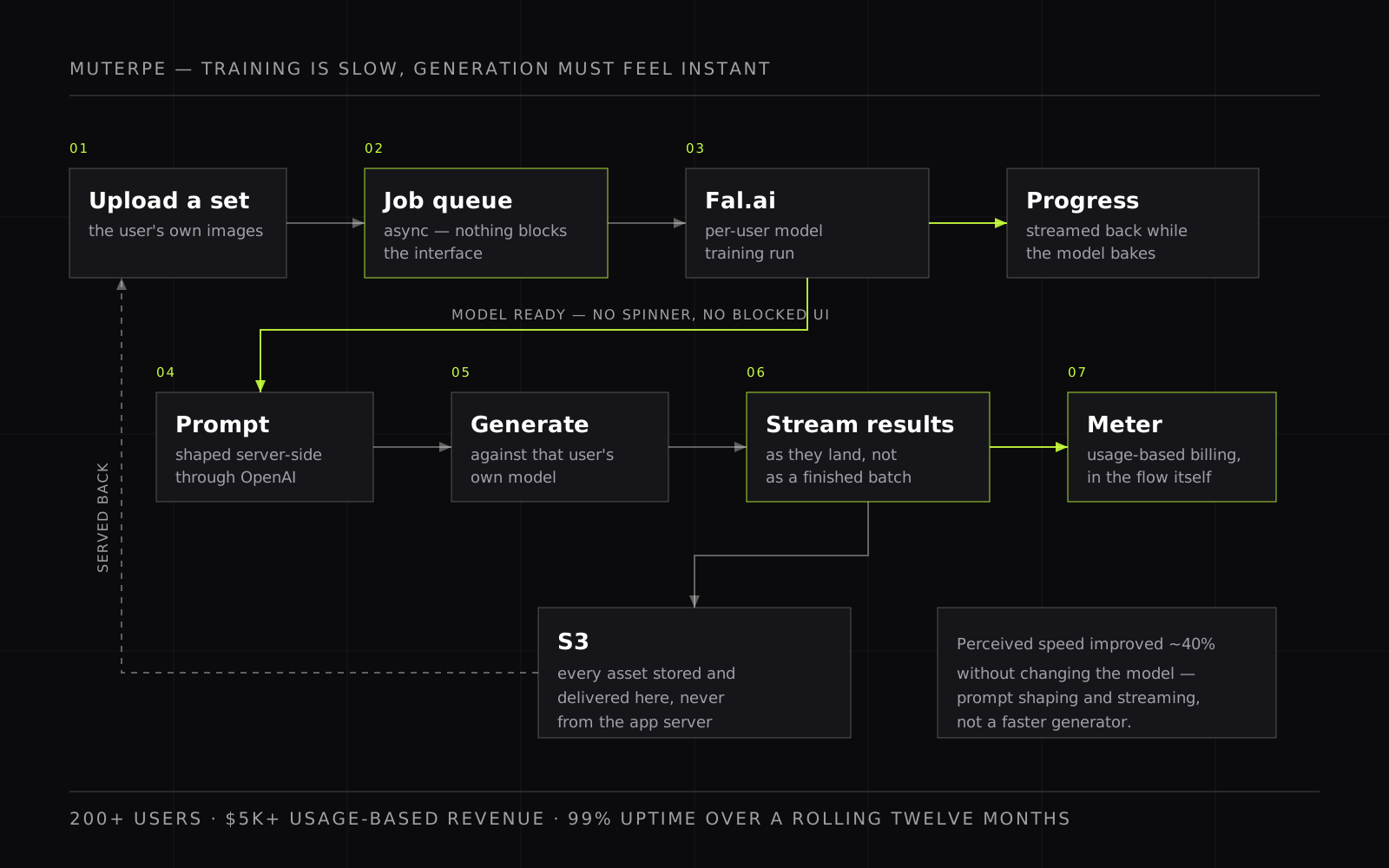
Muterpe train and generate pipeline: an upload enqueues a per-user training job on Fal.ai while the interface stays responsive, and generation shapes the prompt through OpenAI, streams results as they land, meters usage for billing and serves every asset from S3

* TRAIN / GENERATE PIPELINE

Muterpe: Train / generate pipeline

[AT A GLANCE]

ROLE
Founding engineer — pipeline, prompt shaping, storage, metering and billing, end to end
USERS
200+ on self-serve signup, paying for what they generate rather than for a seat
OWNED
Training and generation pipeline · async job queue · asset storage and delivery · usage metering and billing
NOT MINE
The models themselves — training and inference run on Fal.ai, prompt shaping goes through OpenAI
PRODUCT
Train a model on your own images once, then generate against it, billed per generation

[STACK]

  • Next.js
  • React
  • PostgreSQL
  • OpenAI
  • Fal.ai
  • AWS S3

[01] The problem

Generic models don’t hold a likeness

Generic image generators don’t hold a brand or a person’s likeness. Muterpe needed per-user model training, plus a generation pipeline fast enough that users wouldn’t abandon mid-flow.

[02] The constraints

What a per-user model costs before it earns

  1. Every signup costs money before it earns any

    Per-user training consumes GPU time before a customer generates anything, setting a real floor under pricing and free access.

  2. The wait is at the front, where people leave

    Training takes minutes before the first result, so progress and responsive background work are essential to first-run retention.

  3. The training set is photographs of the user

    Training images contain personal data, so storage and delivery were designed around access control rather than convenience.

[03] The approach

How it was built

Training and generation run as queued jobs, while progress and partial results stream to the interface. Slow model work never blocks the application.

[KEY DECISIONS]

  1. [01]Trained one model per user on Fal.ai behind an asynchronous job queue.
  2. [02]Shaped prompts server-side and streamed generated images as they arrived.
  3. [03]Metered generation in the workflow so billing tracks the operation with real unit cost.

[04] The trade-offs

Where quality beat instant

  1. [01]

    Rent the model runtime rather than run GPUs

    Instead of
    Self-host training and inference, which is cheaper per run at volume and gives you the whole stack
    What it cost
    Fal.ai sets the price floor and controls cold starts and queue depth.
    What it bought
    The product shipped without GPU capacity planning, driver maintenance or idle infrastructure cost.
  2. [02]

    Train a model per user

    Instead of
    Prompt one shared model with the user's photos as reference images, which needs no training step at all
    What it cost
    Each account incurs training time, GPU cost, storage and a slower first run.
    What it bought
    Likeness remains more consistent than reference-image prompting, the product’s core value.
  3. [03]

    Stream partial results instead of returning a finished batch

    Instead of
    Wait for the set to complete and render it at once, which is far simpler to reason about
    What it cost
    The interface must handle partial state, cancellation and mid-stream failures.
    What it bought
    Time to first visible result improved by about 40% without changing the model.
  4. [04]

    Charge per generation, not per month

    Instead of
    A flat subscription, which is easier to sell and far easier to build
    What it cost
    Metering must handle partial failures, retries and cancellations in the request path.
    What it bought
    Revenue follows the GPU-backed operation instead of relying on average usage assumptions.

[05] The build

Train, then generate

  • [01]

    Per-user model training

    Users upload a set, the job queue picks it up, and training progress streams back to the UI. Nothing about the app is blocked while a model bakes.

  • [02]

    Generation that feels immediate

    Prompts are shaped server-side before they hit the generation provider, and results stream in as they land. Perceived speed improved ~40% without changing the underlying model.

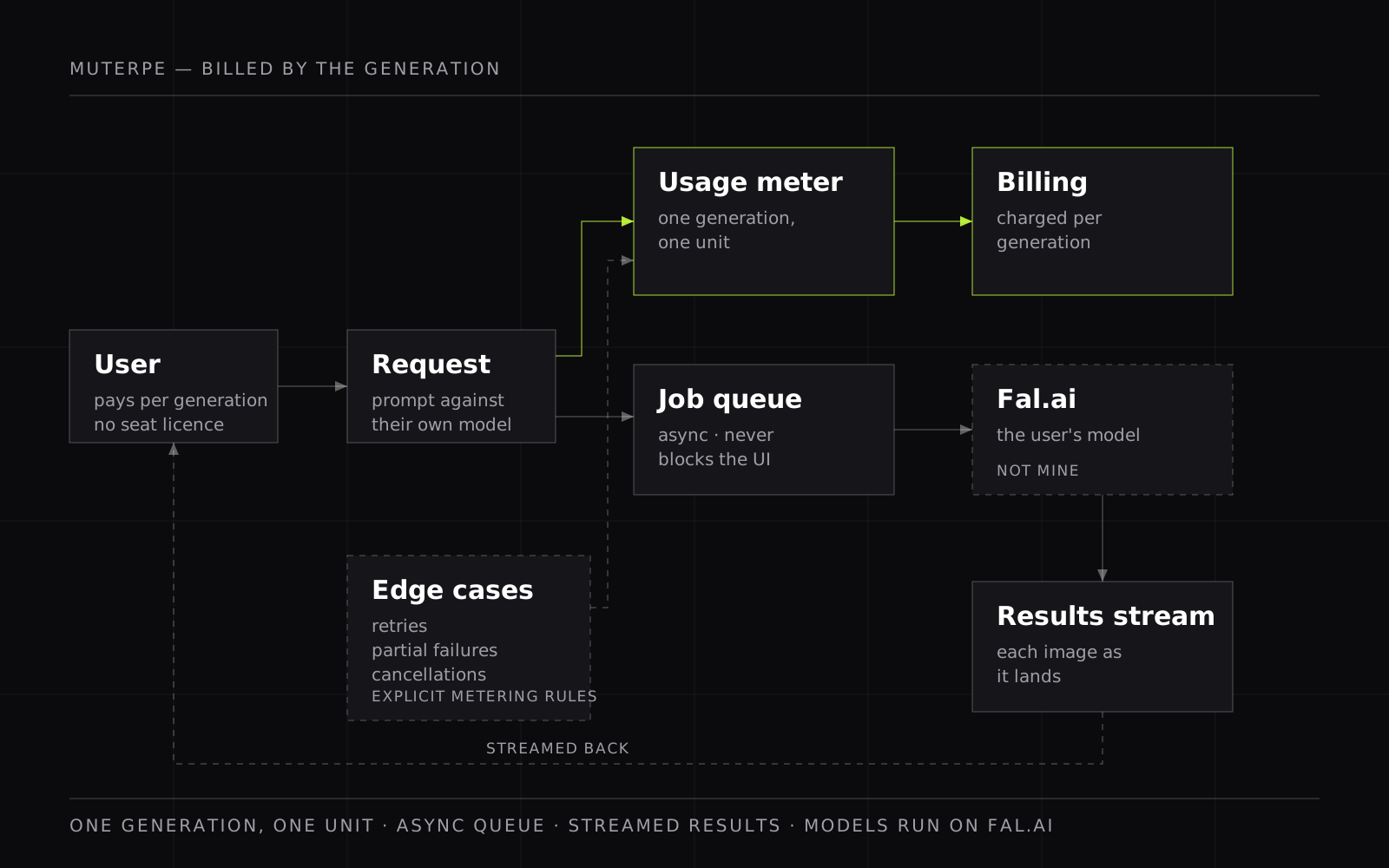
Muterpe billing: each generation request is metered as one unit and billed per generation rather than per seat; the job runs through an async queue on Fal.ai against the user's own model, results stream back as they land, and retries, partial failures and cancellations follow explicit metering rules

Metering, added later than it should have been

[03]

Metering, added later than it should have been

Billing arrived after the pipeline, so partial failures, retries and cancellations needed rules after the fact. Metering now works, but should have shaped the workflow from the start.

[06] The result

What Muterpe measured

  • 200+

    Users

    * self-serve signup

  • $5K+

    Revenue

    * usage-based

  • 99%

    Uptime

    * rolling 12 months

  • ~40%

    Faster, perceived

    * streaming, vs. first release

[HOW THESE WERE MEASURED]

Users and revenue come from platform and billing records. The ~40% measures time to first visible result against the first release, not model throughput. Uptime is the rolling twelve-month monitoring figure.

[07] What I’d do differently

Honestly

Usage metering arrived too late and cost more to retrofit than to design upfront. Next time I would meter first and price second.

Written by Faizan Amir

Role on Muterpe: Founding Engineer

Last reviewed

Need something like this built?

Next case study [07]

Field-Force & Distribution Platform

Read the case study →
AVAILABLE FOR SENIOR ENGINEERING WORK + REACT + NEXT.JS + NODE.JS + PYTHON + RAG + AGENTIC AI